
Did Mid-Decade Redistricting Make Congressional Districts Less Competitive?

In recent weeks, the New York Times and Politico both ran articles making the same basic claim: aggressive partisan mid-decade redistricting in Republican states has reduced the number of competitive congressional districts.
This is a surprising and counterintuitive claim. In many states, incumbents and skeptical Republican strategists openly expressed concern that the new maps would create too many competitive seats. They worried that the previous maps were carefully crafted with sufficient margins to withstand pro-Democratic waves, whereas attempts to crack the few remaining metro-area Democratic districts to get an extra seat would require placing too many Democrats in suburban districts with Republican incumbents. The warnings of these skeptics were central to the failure of redistricting efforts in Indiana, Nebraska, Kansas, and South Carolina.
Republican gerrymandering enthusiasts portrayed these skeptics as risk-averse hand-wringers. The advantage of a mid-decade gerrymander, they argued, is that one has fresh data to work with and can identify places on the map where voters have realigned and new opportunities have emerged in the years since the census. They reassured their colleagues it was possible to gain safe seats without additional risk, and with this logic they won the intra-party arguments in Florida, Missouri, North Carolina, Tennessee, and Texas.
The New York Times and Politico analyses would seem to vindicate the claims of the enthusiasts. For instance, according to their analysis, Florida Republicans were able to gain 3 safe seats, and the number of competitive seats fell from 5 to 1. Texas Republicans gained 5 safe seats, and the number of competitive seats fell from 2 to 0.
However, skeptics might point to the fact that Democratic strategists are investing heavily in many of these “safe” Republican seats, and participants in betting markets view several of them as quite competitive—with Democrats even favored in some. Local media outlets in Texas, Missouri, Florida, and North Carolina portray the mid-decade redistricting as having increased the competitiveness of several districts.
Who is right? The answer depends on how much weight one places on the geography of the 2024 Presidential Election when predicting future elections. The strategy of Republican map-drawers, and the classification scheme adopted by the Times and Politico, assumes that the conditions of the 2024 election will be replicated in 2026 and beyond. A district is “safe” if the margin of victory of Donald Trump or Kamala Harris was more than 10 percentage points in 2024.
However, when evaluating redistricting plans, specialists typically examine results of all statewide elections held over several cycles. The idea is to avoid drawing conclusions based on a single election that might be idiosyncratic. For instance, should one anticipate that the sudden surge of Tejano votes for Donald Trump in South Texas, or the unexpected turn against Democrats in the urban core of large cities, will continue in future elections? Is it sensible to ignore Sherrod Brown’s strength relative to Kamala Harris in working-class areas in Ohio? How should one account for the fact that a key feature of the 2024 Presidential Election was anti-incumbent punishment related to inflation?
If we examine the average Democratic and Republican vote shares of all statewide elections from 2016 to 2024 and identify the districts with a margin of less than 10 percentage points, we come to a different conclusion than if we focus exclusively on the 2024 presidential election. Texas, instead of going from 2 competitive districts prior to the mid-decade redistricting down to 0 after, as in the New York Times analysis, goes from 2 to 4. Florida, instead of going from 5 competitive districts down to 1, goes from 2 to 4. With this approach, North Carolina had 3 competitive districts prior to gerrymandering and now has 4. The number of competitive districts associated with the mid-decade redistricting effort is unchanged in Ohio (3), Missouri (0), and Tennessee (0). Each of these estimates is quite in line with the number of districts currently viewed as competitive in betting markets.
Figure 1: The Distribution of Partisanship in 2026 Maps in Florida, Missouri, North Carolina, Ohio, Tennessee, and Texas, Presidential 2024 Data Versus Long-Term Averages
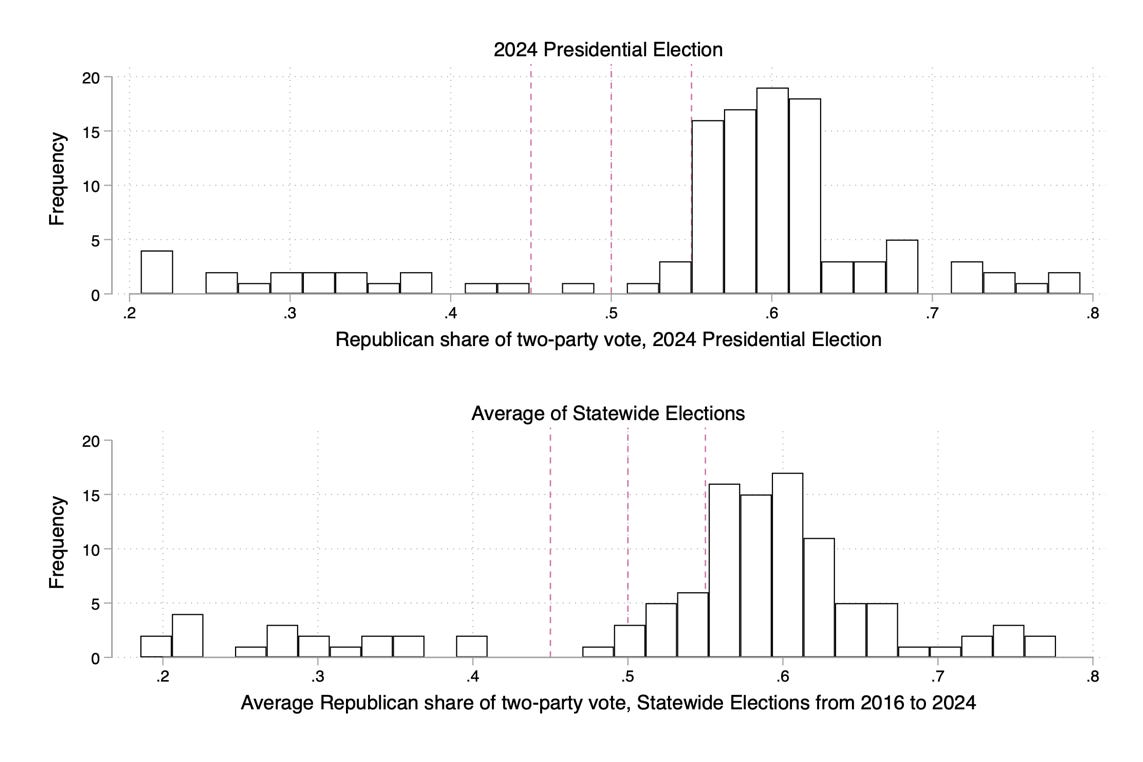
The histogram above presents the distribution of partisanship across the 2026 districts in the set of 6 states recently redistricted by Republicans, using data from the 2024 Presidential Election in the top panel, and the average of all statewide races from 2016 to 2024 in the bottom panel. I exclude Alabama and Louisiana, where legal challenges are ongoing. It appears that Republican district-drawers were making a conscious effort to draw districts that were at least 55 percent Republican, and their focus was clearly on the 2024 Presidential Election. They left only 5 districts in the “competitive” range between 45 and 55 percent according to this metric. If we examine a larger number of elections, however, this number expands to 15.
The histograms also reveal a larger concern emphasized by Republican redistricting skeptics: whichever metric one uses, there are many districts just barely beyond the talismanic 55 percent safety threshold. A very significant swing toward the Democrats, perhaps due to inflation, an unpopular war, or even the entirely predictable mid-term punishment of the incumbent president, would create a much larger number of competitive districts. Many of the districts just beyond the range deemed competitive by the New York Times include relatively “swingy” suburban areas. Risk-averse Republican strategists recall that their party lost “safe” metro-area seats in Charleston, Oklahoma City, and Salt Lake City in the 2018 blue wave during the first Trump Administration.
It is possible that the enthusiasts will be vindicated, and Republicans will win every “safe” seat they have created, but there are good reasons to be skeptical of the claim that the recent aggressive gerrymanders will reduce the number of competitive districts in 2026. In fact, in the 6 states conducting mid-decade redistricting, the Democratic Congressional Campaign Committee targeted only 3 seats in 2024 but is now targeting 13.
The aspiration of aggressive gerrymandering is to eliminate competitive districts, but this can be difficult to achieve in practice. Despite intense polarization, vote choice and turnout are still volatile in some slices of the electorate, and large swings are still possible. Past statewide results are sometimes surprisingly poor predictors of outcomes in congressional races.
Moreover, the task in the Republican mid-decade redistricting effort was to improve on what were already very aggressive gerrymanders while making sure to minimize changes to the districts of sitting incumbents. If starting from a blank slate and paying no attention to existing district lines or the incumbents who defend them, Republican operatives could have probably picked up seats while reducing the number of competitive districts. However, given the constraints they faced, their maneuvers will not only add Republican-leaning seats, but also make election night more interesting.
Do you have a list of these 15 districts?